ANIMAL BREEDING
Breeding for healthier animals, sustainable food systems and future challenges.
what is animal breeding?
Animal breeding is the process of selecting animals with desirable characteristics to contribute to future generations.
For centuries, farmers and breeders have used their knowledge and experience to select animals with traits that are important for farming, such as productivity, health, and adaptation to their environment.
Today, animal breeding combines this expertise with scientific knowledge and advanced technologies.
By analysing genetic information together with data on animal performance, health, and welfare, breeders can make more informed decisions and improve a wider range of traits.
Modern breeding is therefore not only about producing more. It is about developing animals that are healthy, resilient, efficient, and adapted to sustainable farming systems.
How has animal breeding evolved?
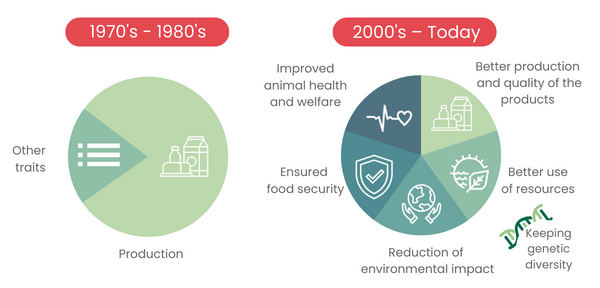
Historically, breeding decisions were mainly based on observing animals and selecting those with desirable characteristics.
Traits such as milk production and quality, meat quality, or growth were among the first characteristics considered.
Over time, scientific progress has allowed breeders to better understand the relationship between genetics and animal performance. Today, breeding programmes consider a much broader range of traits, including:
- animal health and disease resistance,
- welfare and robustness,
- fertility and longevity,
- adaptation to changing environments,
- reduced environmental impact,
- efficient use of feed resources,
- quality of animal products.
This evolution has transformed animal breeding into a science-based approach that supports the development of sustainable food systems.
Why is animal breeding important?
Food production faces major challenges, including climate change, biodiversity loss, and the need to produce safe and nutritious food while reducing environmental impacts.
Animal breeding contributes to addressing these challenges by helping farmers develop animals that are better adapted, healthier, and more efficient.
European animal breeding plays an important role in supporting more sustainable livestock and aquaculture systems: Breeders work together with researchers, farmers, policymakers, and other sectors to develop solutions that consider both current and future challenges.
Modern animal breeding is recognised as an important contributor to achieving the United Nations Sustainable Development Goals (SDGs), particularly those related to sustainable food production and responsible resource use.
Resources:
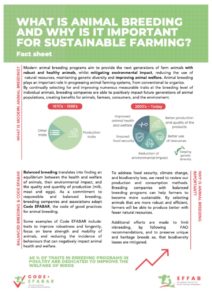
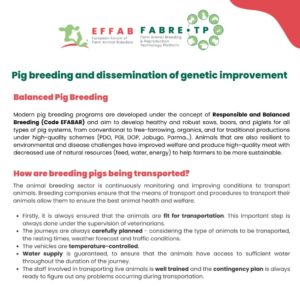
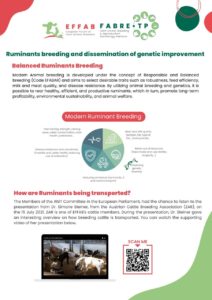
what is intended by responsible and balanced animal breeding?
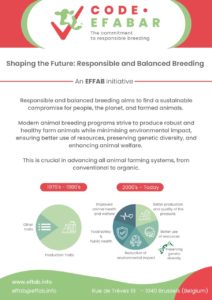
Animals are complex, and sustainable progress cannot be achieved by focusing on a single characteristic. Responsible and balanced breeding means finding the right balance between different objectives:
- the health and welfare of animals,
- the environmental impact of farming,
- the quality and quantity of animal products,
- the needs of farmers and society,
- the preservation of genetic diversity.
A balanced approach ensures that improvements in one area do not negatively affect others.
For example, breeding programmes aim to improve traits such as:
- robustness and longevity in dairy animals,
- leg strength in pigs and poultry,
- positive behaviour traits,
- disease resistance in aquaculture,
- improved feed efficiency,
- reduced environmental emissions.
Through balanced breeding approaches, animals can become more resilient while contributing to sustainable production systems.
As a commitment to responsible and balanced breeding, EFFAB members adopt Code EFABAR, the code of good practices for animal breeding.
The code is based around 6 pillars from animal health and welfare to food safety and recognizes the central role of sustainability in safeguarding food security.
The Code is reviewed every 3 years and the next version will be presented in 2026.
Animal Health and Welfare
Improving animal health and welfare is essential to meet society’s demands for ethical food productions, ex.: improving robustness, improving positive behavior.
Environment
Reducing the environmental footprint of food production is central to animal breeding best practices, ex.: reducing methane and ammonia emissions.
Product Quality
Product quality is a key focus for animal breeding organizations. The most appropriate animals in population are selected for key trait like leanness of meat.
Genetic Diversity
Making sure there is a high level of genetic diversity within populations is a prerequisite for responsible and balanced animal breeding programmes.
Better use of resources
Better use of resources is central to Code EFABAR and can be achieved through techniques like breeding animals with optimal feed use and increased longevity.
Food Safety and Public Health
Animal Breeding organizations work to reduce the risk of diseases being transmitted from animals to humans. By improving resistance to diseases, they reduce the use of antimicrobials and food waste.